A clear, practical guide to how reverse mortgages work, who they’re designed for, and how they fit into a broader financial plan.
Written for Ontario homeowners planning retirement income, mortgage payoff, or long-term flexibility.
Most homeowners — and their families — come into this conversation with serious concerns about reverse mortgages.
That’s reasonable, and it’s exactly how you should approach a decision like this. There’s a lot of conflicting information out there, and much of it focuses on worst-case scenarios without explaining how these loans actually work in practice.
“Will I lose my home?”
“Will the debt grow out of control?”
“Will this leave my children with a problem later?”
“Is this something I can’t undo once I start?”
These are not small questions — they’re the right questions
Before deciding whether a reverse mortgage makes sense, it’s important to understand how they actually work — beyond headlines, assumptions, and worst-case scenarios
A reverse mortgage is a loan that allows homeowners aged 55 and older to access a portion of their home’s equity without selling the home and without making regular mortgage payments. It’s often misunderstood because it works very differently from a traditional mortgage — and because many explanations focus on extremes rather than how these loans are used in real life.
You borrow money
You make monthly payments
Over time, your mortgage balance usually goes down
Missed payments can put the home at risk
You borrow money using your home as security
You do not make required monthly mortgage payments
Interest is added to the balance over time
You remain the homeowner at all times
With a reverse mortgage, the lender does not take ownership of your home.
Your name stays on title, and you remain in control of the property. The loan is typically repaid later — when the home is sold, the homeowner moves out permanently, or the estate settles the loan.
As long as you continue to:
Live in the home as your primary residence
Pay property taxes
Maintain home insurance
Keep the property in reasonable condition
you are not required to repay the loan, and you are not forced to move.
Reverse mortgages in Canada also include a built-in safeguard:
the amount owed can never exceed the fair market value of the home at the time it’s sold. This means neither the homeowner nor the estate can be left owing more than the home is worth
Now that the structure is clear, the next step is understanding how a reverse mortgage would work in real life — using actual numbers and realistic scenarios.
In practice, reverse mortgages are rarely used as a single, all-or-nothing decision. Instead, they’re usually part of a broader financial plan — designed to solve a specific problem, over a specific period of time, while preserving flexibility for the future.
Age: mid-70s
Home value: approximately $1–$3 million
Existing traditional mortgage: still in place
Monthly mortgage payments reducing available cash flow
Retirement income is stable, but feels tight
No desire to sell the home today
Preference to downsize later, when timing and market conditions make sense
One of the first uses of a reverse mortgage is often to pay out an existing traditional mortgage. This immediately eliminates required monthly mortgage payments, improving cash flow without selling the home.
After the existing mortgage is paid out, remaining funds can be accessed in different ways — depending on the homeowner’s goals.
This may include:
A one-time lump sum
Regular monthly advances
Or a combination of both
These funds are loan proceeds, not employment income, and are generally not taxable
In many cases, homeowners do not use the full amount available to them. Instead, the reverse mortgage acts as a flexible tool — providing access to funds when needed, while leaving unused equity untouched.
Because there are no required monthly payments, interest is added to the reverse mortgage balance over time. This means the balance gradually increases — which is why understanding the time horizon and long-term plan is essential.
The homeowner plans to sell or downsize later
The property value is high relative to the amount borrowed
The reverse mortgage is being used as a bridge, not a permanent solution
The home is sold
The homeowner moves out permanently
Or the estate settles the loan
At that point, the loan is repaid from the sale proceeds, and any remaining equity belongs to the homeowner or their estate
The key takeaway is that a reverse mortgage isn’t a product decision — it’s a planning decision. Whether it makes sense depends entirely on age, home value, existing debt, income needs, and future plans.
A reverse mortgage is a powerful tool in the right situation — and the wrong one in others
1. The homeowner plans to sell or move in the near term
If a sale or permanent move is likely within the next 12–24 months, the costs and setup of a reverse mortgage often outweigh the benefits.
In those cases, other short-term strategies may make more sense.
2. Monthly income can already be improved in simpler ways
Sometimes the issue isn’t access to equity — it’s:
Expense structure
Pension timing
Tax planning
Downsizing decisions
If income can be improved without borrowing against the home, that path should be explored first.
3. The homeowner is uncomfortable with a growing loan balance: even when the numbers work, some people simply do not like the idea of interest accumulating over time. That discomfort matters.
A reverse mortgage should reduce stress — not create it.
4. There is little equity relative to the homeowner’s goals Reverse mortgages work best when:
Property value is strong
Borrowing needs are modest relative to that value
If equity is limited, the flexibility may be too constrained to justify the structure.
5. Family alignment has not been discussed
If adult children or beneficiaries are strongly opposed — or misunderstand how reverse mortgages work — it’s usually best to pause and have those conversations first. Good planning avoids surprises later.
A reverse mortgage should never be used to “force” a solution. When it makes sense, it should feel logical, measured, and aligned with the homeowner’s broader plan — not rushed or reactive.
Reverse mortgages in Canada are governed by strict rules designed to protect homeowners and their estates.
The lender does not own the home
Title stays in the homeowner’s name
You are never required to sell as long as conditions are met
No mandatory payments
Interest is added to the balance over time
Optional payments may be made, but are not required
To keep the home, the homeowner must:
Live in the home as their primary residence
Pay property taxes
Maintain home insurance
Keep the property in reasonable condition
These rules exist to prevent homeowners from being put at risk
The loan balance can never exceed the fair market value of the home at sale
The estate is not responsible for any shortfall
This protection applies even if home values decline
Every reverse mortgage requires independent legal advice
Lawyers are required to confirm understanding
No one can “rush” this process
A reverse mortgage is not designed to take advantage of homeowners — it is designed to work within clearly defined limits. Understanding those limits is what allows families to evaluate the option rationally, rather than emotionally.
When homeowners start looking at reverse mortgages, it’s usually because other options either aren’t available — or don’t solve the problem as cleanly.
A reverse mortgage is rarely the first option considered.
In practice, it’s usually evaluated alongside refinancing, HELOCs, or selling the home. Understanding how these options differ — and where each one breaks down — is essential before deciding what makes sense.
For homeowners who qualify, refinancing or a HELOC can be effective tools.
They generally offer lower interest rates and are familiar products.
When this works best:
Strong income qualification
Good credit
Comfort with monthly payments
Long-term employment or pension income
Where it often breaks down:
Monthly payments reduce cash flow in retirement
Qualification becomes harder with age or fixed income
Increasing debt obligations later in life may add stress rather than relief
Key takeaway:
These options work well when income supports them. When income is the constraint, they can worsen the problem they’re meant to solve.
Selling the home is sometimes the cleanest financial solution — but it’s also the most disruptive.
When this works best:
The homeowner is ready to move now
Timing and market conditions are favourable
Lifestyle change is already planned
Where it often breaks down:
The homeowner wants to stay in the home longer
Market conditions are uncertain
Selling now creates unnecessary pressure or regret
Key takeaway:
Selling solves everything at once — but removes flexibility. Many homeowners prefer to decide when to sell, rather than being forced to.
A reverse mortgage is typically considered when the goal is to improve cash flow without selling the home and without adding monthly payments.
Where it fits best:
The homeowner has significant equity
Income is fixed or limited
Staying in the home matters
Flexibility around when to sell is important
Trade-offs to understand:
Interest accumulates over time
The loan balance increases rather than decreases
Long-term planning matters
Key takeaway:
A reverse mortgage is not about maximizing borrowing — it’s about solving a specific problem while preserving control and flexibility.
There is no universally “better” option — only a better fit for a specific situation. The right choice depends on age, income stability, equity, lifestyle priorities, and long-term plans — not just interest rates.
Our role isn’t to recommend a product — it’s to help families make a decision they’ll still feel comfortable with years from now.
When homeowners and their families speak with us about reverse mortgages, the goal isn’t to move quickly or reach a predetermined outcome. The goal is to understand the full picture — and then determine whether a reverse mortgage fits logically into that picture, or whether another option makes more sense.
Step 1 — Understand the current situation
We start by understanding where things stand today, including:
Age and stage of life
Property value and existing mortgage balance
Current income sources and monthly cash flow
Short- and long-term housing plans
Without this context, no recommendation is meaningful.
Step 2 — Clarify the problem we’re trying to solve
A reverse mortgage should never be used simply because it’s available. We focus on identifying the specific issue:
Reducing required monthly payments
Creating additional cash flow
Avoiding a forced sale
Preserving flexibility around future decisions
If the problem isn’t clear, the solution won’t be either.
Step 3 — Evaluate all realistic options
Before recommending a reverse mortgage, we consider alternatives such as:
Refinancing or restructuring existing debt
HELOCs or other credit options
Downsizing or selling at a later date
Using existing savings more efficiently
In some cases, the right answer is not a reverse mortgage — and we say that plainly
Step 4 — Model how the plan works over time
When a reverse mortgage is a viable option, we walk through how it would actually work:
How much is used, and when
How the balance changes over time
What happens if circumstances change
How and when the loan would be repaid
Step 5 — Leave the decision with the family
Our role is to explain the trade-offs clearly. The decision itself always belongs to the homeowner and their family — with no pressure to proceed
A reverse mortgage can be a useful planning tool in the right situation — and the wrong one in others. Our responsibility is to help families understand the difference, so they can make a decision that feels considered, informed, and aligned with their long-term goals.
After understanding how reverse mortgages work, how they’re typically used, and where they do and don’t make sense, most families arrive at a clearer picture — even if the answer isn’t immediately obvious. In practice, families usually find themselves in one of two places.
For some homeowners, the information raises practical questions worth exploring further. This is often the case when:
Staying in the home longer matters
Monthly cash flow is more important than minimizing long-term debt
Selling now feels premature
There’s a desire to understand the numbers before deciding
In these situations, the next step is usually not a commitment — just a clearer understanding of how the option would work in their specific case.
Other families conclude that a reverse mortgage isn’t the right solution for them. That may be because selling feels like the better path, income is sufficient without borrowing, or the structure simply doesn’t align with their comfort level. Reaching that conclusion is just as responsible.
The purpose of this guide is clarity, not persuasion. A good decision is one that feels informed, measured, and aligned with the homeowner’s broader plan — whichever direction that leads.
30-second overview
.png)
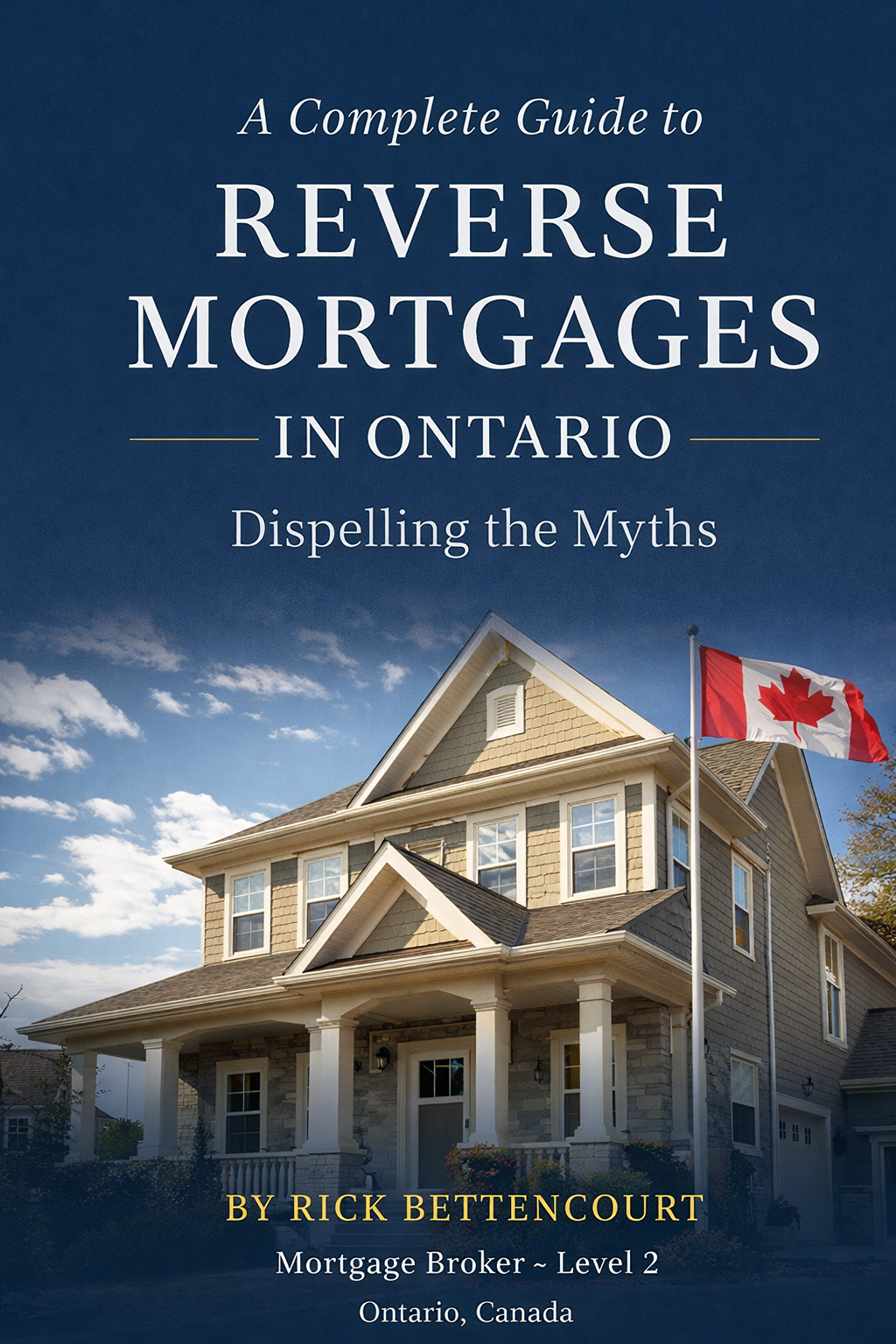
Free Guide: Reverse Mortgages Explained

If you’re considering a reverse mortgage — or simply want to better understand your options — a conversation can help bring clarity.You don’t need to decide anything today.
You just need the right information.






★★★★★ Rated 5 Stars on Google
“Amazing service. Helped me get approved when the banks said no. Very professional, fast, and honest.”
-Shane S.
“Excellent communication. Helped with a rbe happier.”
Lynda B.
“Very knowledgeable and helpful from start to finish. Made the entire mortgage process much easier.”
Domenic V.




Rick Bettencourt, Mortgage Broker Level 2,
FSRA License #M11002425
licensed with Chartered Finance, Brokerage #12791
#302 – 7300 Warden Ave, Markham, Ontario.
Helping Ontario homeowners access practical mortgage solutions with clarity and confidence.
© 2025 Pure Mortgage Advisory Services. All rights reserved.